MECA Strength and Conditioning Overview
“3 Years of Results in 3 months”
Training athletes versus General Populations or Civilians differs in many respects.
Often, the limiting factor is TIME and there is an objective physical goal or quality that needs to be attained or enhanced that will have a direct correlation to improvement on the field of play.
Athletes have a limited amount of time to reach their physical goals; many in less than 12 weeks.
A good strength coach needs to come up with a training plan that is effective and doesn’t waste time in developing the most important physical qualities that the athlete needs in order to be successful on the field of play or their sport of choice.
In training athletes, there can be a variety of different approaches and training methods that can be used.
At MECA, we focus on basic strength training done really well in order help our athletes achieve their goals and be the best that they can be on the field of play.
It comes down to understanding three things:
Training Economy, the Strength – Speed Continuum, and Exercise Based Periodization.
1) Training Economy
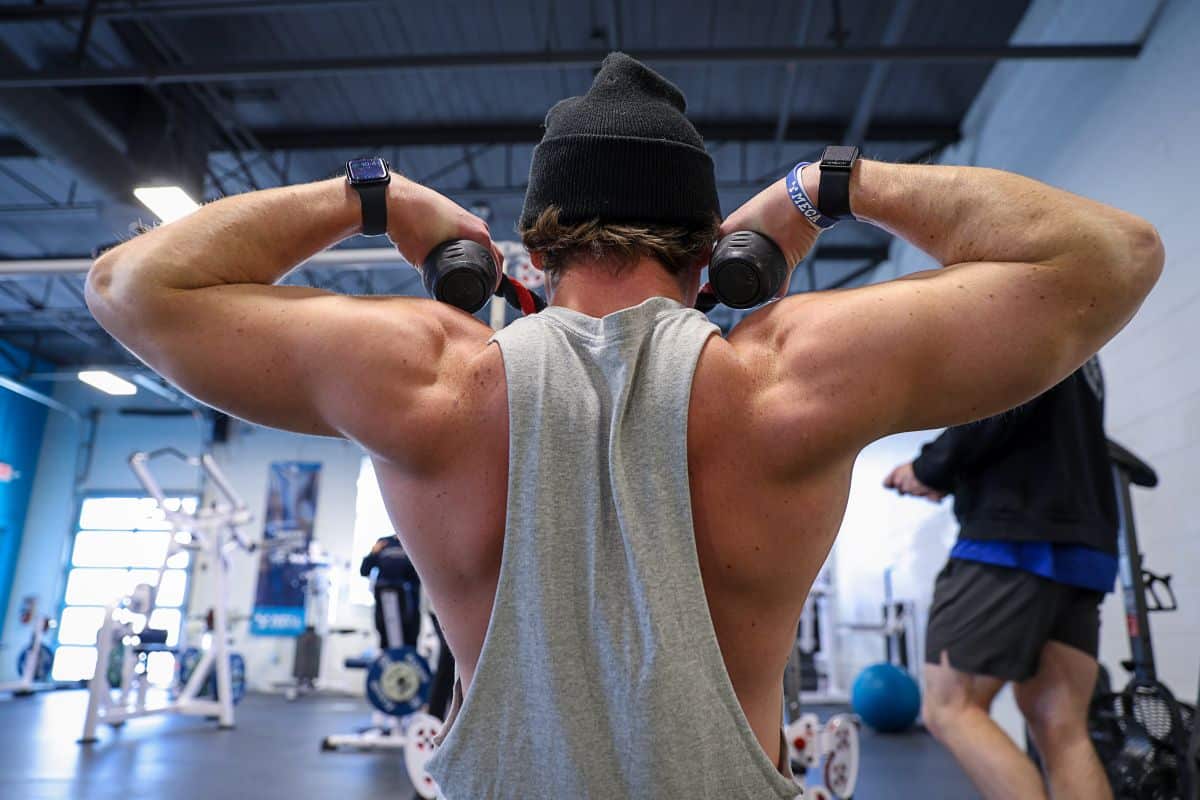
What is the most effective training stimulus that will provide a maximum return on investment in developing the necessary physical qualities to improve in that athlete’s sport?
The answer is strength training.
I might add, strength training through full range of motion.
Improvement in Strength relative or maximal has improvement on all other physical qualities.
“Strength is the mother of all physical qualities”
Strength Improves;
- Speed
- Flexibility
- Mobility
- Range of motion
- Endurance
- Conditioning
- Power
- Balance
- Joint Strength and Stability (joint health)
- Posture
- Strength
The above mentioned are the WHY on the reason for focusing our attention on improving strength instead of many of the other “training modalities” that have become popular like balance training or SAQ training “Speed, Agility, and Quickness”
2) Understanding the Strength – Speed Continuum
2) Understanding the Strength – Speed Continuum.
| Absolute Strength | Strength – Speed | Speed – Strength | Pure Speed |
| Squats / Deadlift | Power Clean | Loaded Jumps | Sprinting |
| Bench Press | Jumping Push Up | Med Ball Toss | Throw an implement |
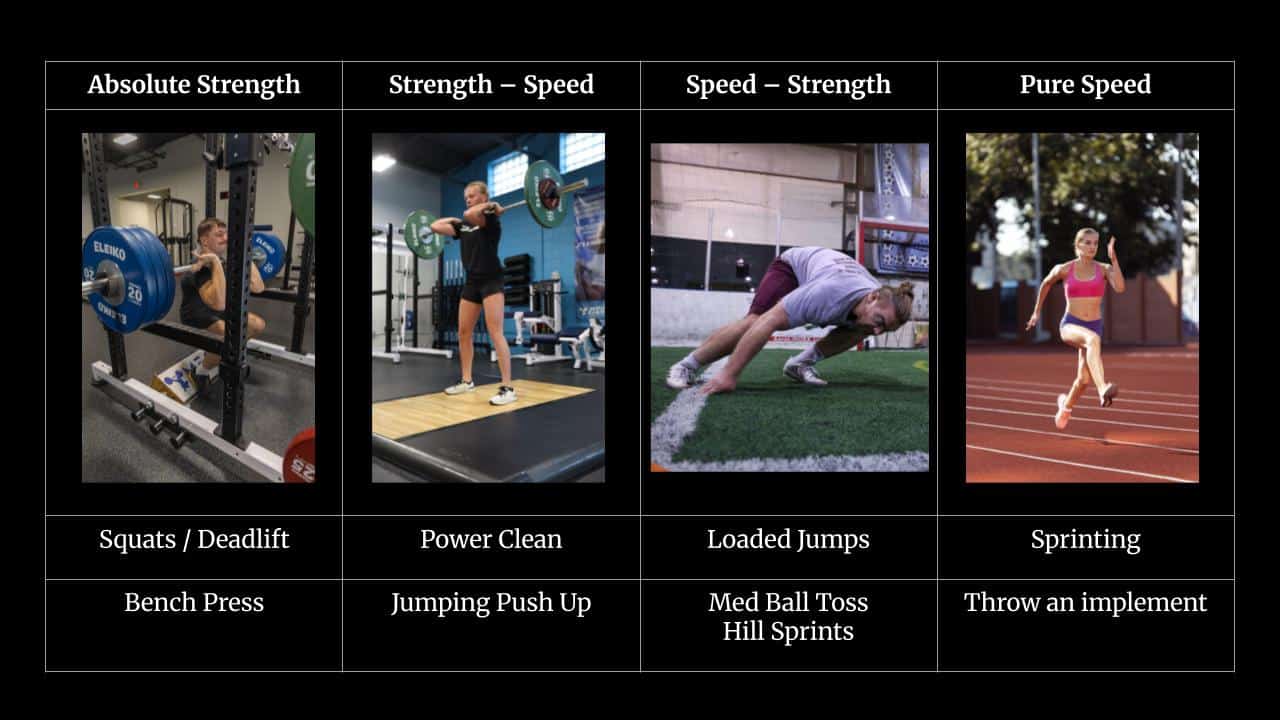
Most athletes that play team sports spend the majority of their time on the Absolute Speed end of the Strength – Speed Continuum.
Each time an athlete practices or plays a game, those physical qualities and abilities of that sport are being developed.
These usually involve sprinting, changing direction, accelerating and decelerating.
Most of these involve fast dynamic contractions with little to no external load or force.
In sports like American Football, or Rugby there can be high amounts of external force applied during the game and practices at certain times and depending on the position played.
However, the reason why most if not all of our younger athletes (high school, grade school etc.) do so well on a basic strength training program for the first time is because they haven’t been very exposed to the (absolute strength) end on the spectrum.
Improving strength allows the athlete to produce more force into the ground as well as gain a host of other physical qualities or attributes.
Full Range of Motion and Structural Balance
In improving strength for athletes, the goal is to get our athletes to achieve the full range of motion possible for the joint(s) in a movement pattern and only then add external load.
If range is limited even slightly, neural inhibition is increased and less motor units are innervated/recruited.
This will ultimately lead to less force output and less speed on the field of play.
In movements like squats or split squats, full range of motion allows more synovial fluid to lubricate and nourish the joint.
This is a restoration effect that gives the body the nutrients to build stronger tendons and ligaments.
To overview this, it would be called structural balance.
In this phase we work hard at getting the athlete to the right body fat percentage and overall body weight (muscle mass) required to be effective in their sport.
Relative Strength Development
After range of motion is achieved, we then work on developing relative strength or improving strength to weight ratios.
Our number we like to see is an athlete Back Squat a minimum of 1.82 x BW or Front Squat 1.55 x BW.
This varies from sport to sport.
Different sports need higher or lower levels of maximal strength.
This can take anywhere from 6 months to 3 off-seasons of training.
But the goal is to really develop a high amount of strength or improve the Absolute Strength end of the Strength to Speed Continuum.
 Strength-Speed Development
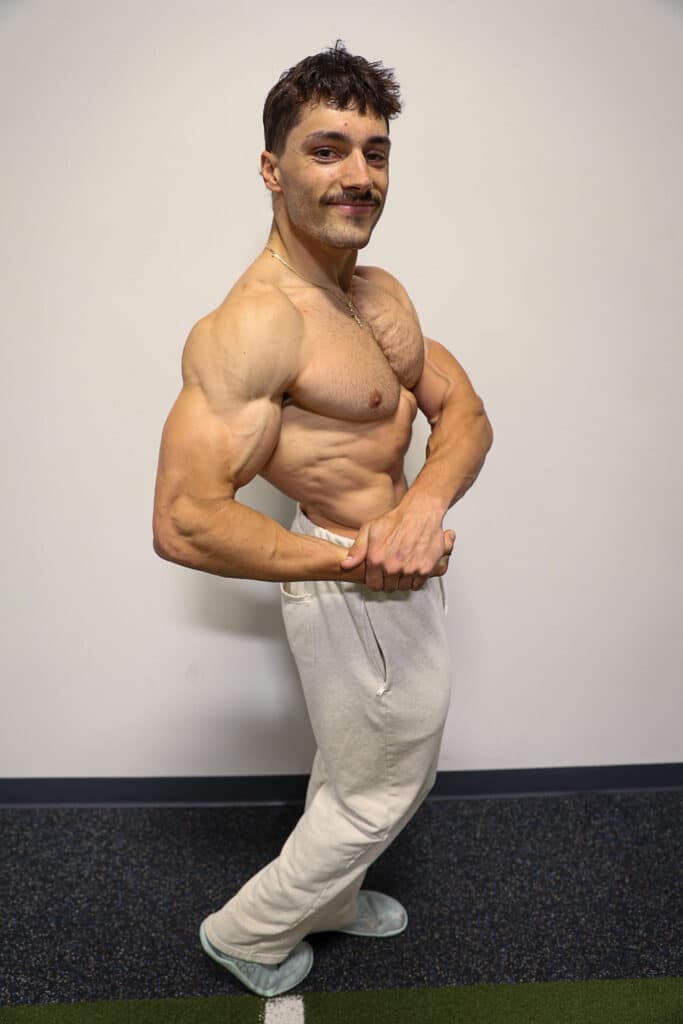 Strength-Speed Development
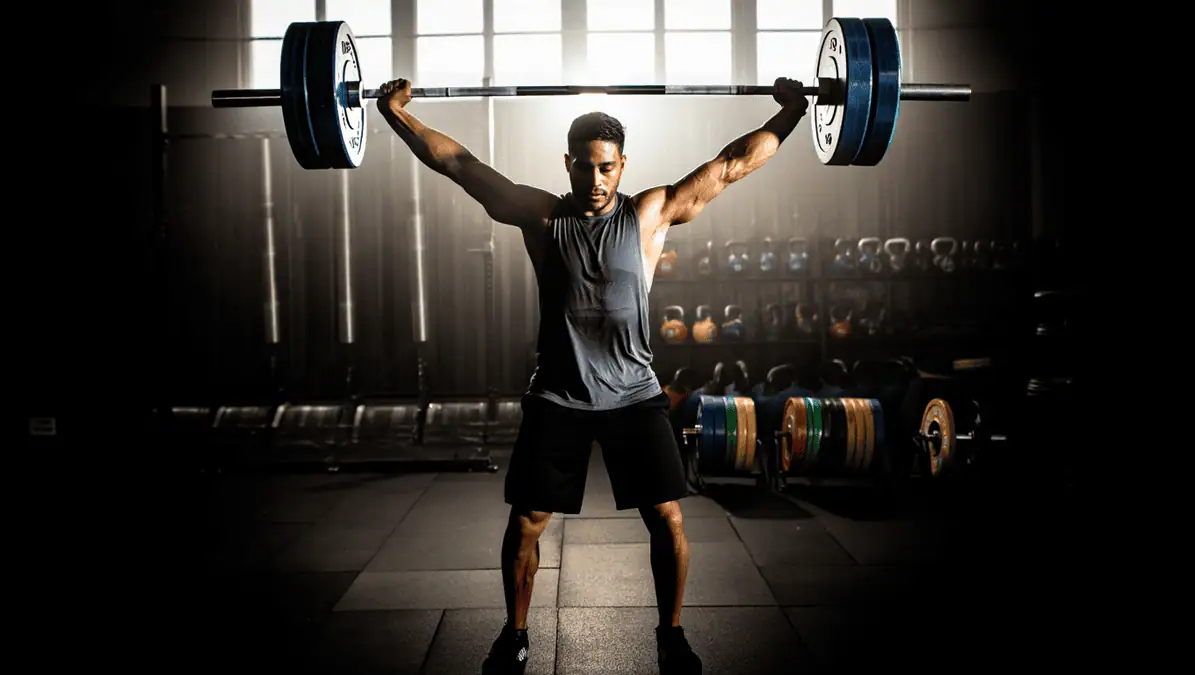
When these basic levels of strength have been achieved, we look to change the velocity or speed of the movement and begin to incorporate more Olympic Lifting in our training programs.
Cleans, Snatches, Jerks etc. to improve the rate at which our athletes can develop force.
What we have found is that by changing the velocity and speed of contraction, strength in the classical lifts like Back Squat and Deadlifts improve at a faster rate than if we had just kept a basic strength training program.
This works in a two-fold way.
This not only improves the strength-speed end of the continuum, but also more rapidly drives up the absolute strength end as well.
This is where a lot of the “magic” happens for athletes who have a good strength base but really need to get stronger and more powerful to improve in sport.
Olympic lifting can provide a better training transfer in some sports where an athlete needs to accelerate from a dead stop.
In Olympic weightlifting, the initial movement of the lift is a concentric contraction.
This differs from traditional exercises like Squats and Bench Press, where the initial movement is an eccentric contraction utilizing the stretch reflex aids in acceleration of the movement.
Speed and Power Development
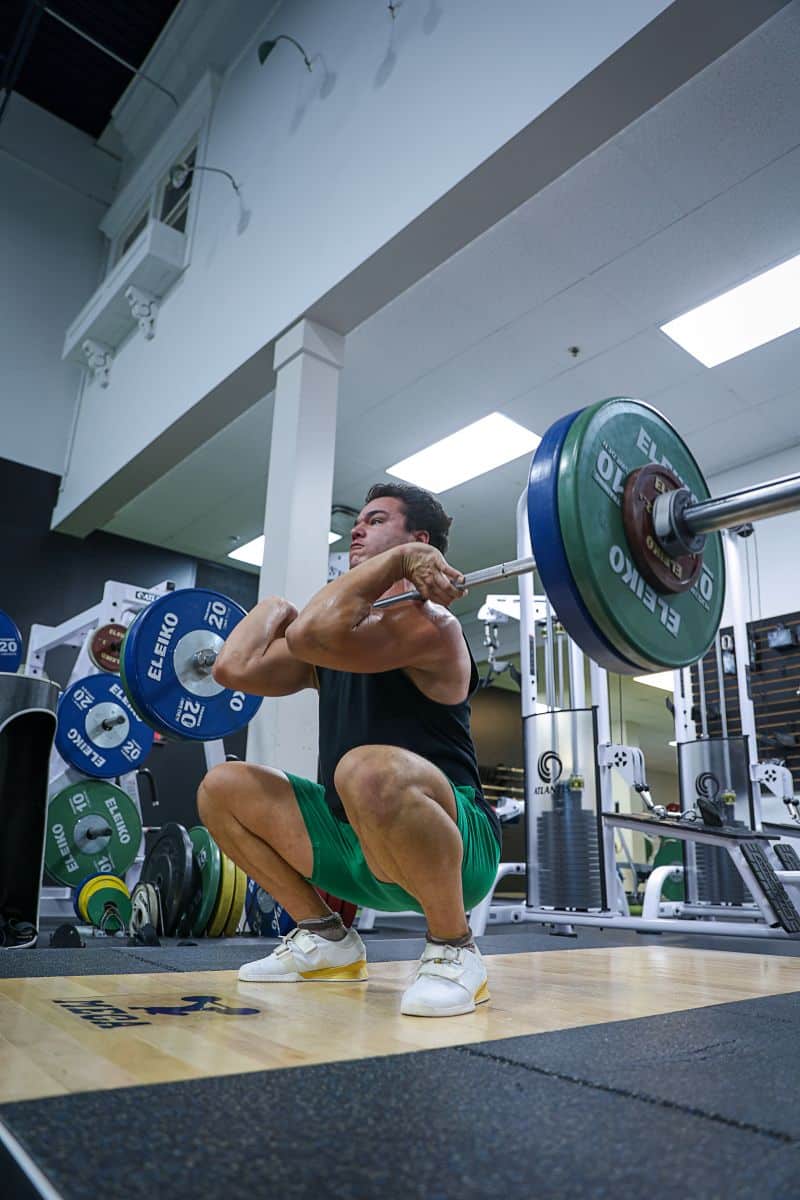 Speed and Power Development
Once athletes can Back Squat 2.23 x BW or Clean 1.7 x BW we begin to look at the right end of the continuum and focus on plyometrics like jumping and bounding.
Once and athlete is strong enough and can produce a lot of power; this is where adding in plyometrics can be maximally beneficial.
We also look at possibly adding in a sprinting program 2x a week to make sure that the right physical qualities are being trained to ensure maximal speed and velocity are achieved for that athlete in that sport.
I would say only 2-3% athletes out of 100 get to this position as strength is really the primary driver in improvement sports performance.
3) Exercise Based Block Periodization
This goes back to training economy.
The human body can only adapt optimally to a very few stimuluses at once.
With physical development – the athlete can adapt to get bigger, get stronger, get faster, get leaner, get more flexibility etc.
Only one or two physical qualities can be optimally trained at a time.
Using exercise based block periodization means that first – the training program is based on the exercise being performed or introduced to the athlete.
This is where the trainer is so important in progressing or regressing the exercise for optimal outcomes and adaptation for the athlete/client.
2nd we use structures or blocks of training to impose a specific demand and hopefully a specific outcome whether it be size, strength, speed etc.
Each block of training has carry over effects and diminishing returns.
Training for a block for a period of time is important for the athlete to adapt – but if too long the athlete will stagnate and adaptation becomes limited or retarted.
Introducing new exercises in progression each phase with a specific goal of achievement will aid in providing the necessary stimulus to push the athlete to adapt.
We will go into much more detail in the future sections.
STRENGTH (Charles – Sport Specific Sweden)
Strength is correlated with all the other qualities (ie. Speed and endurance)
- strength is the mother of all qualities because it affects everything else.
- For instance the stronger you get, the faster you will be at moving the same load, also the stronger you get the more times you will be able to move the same load.