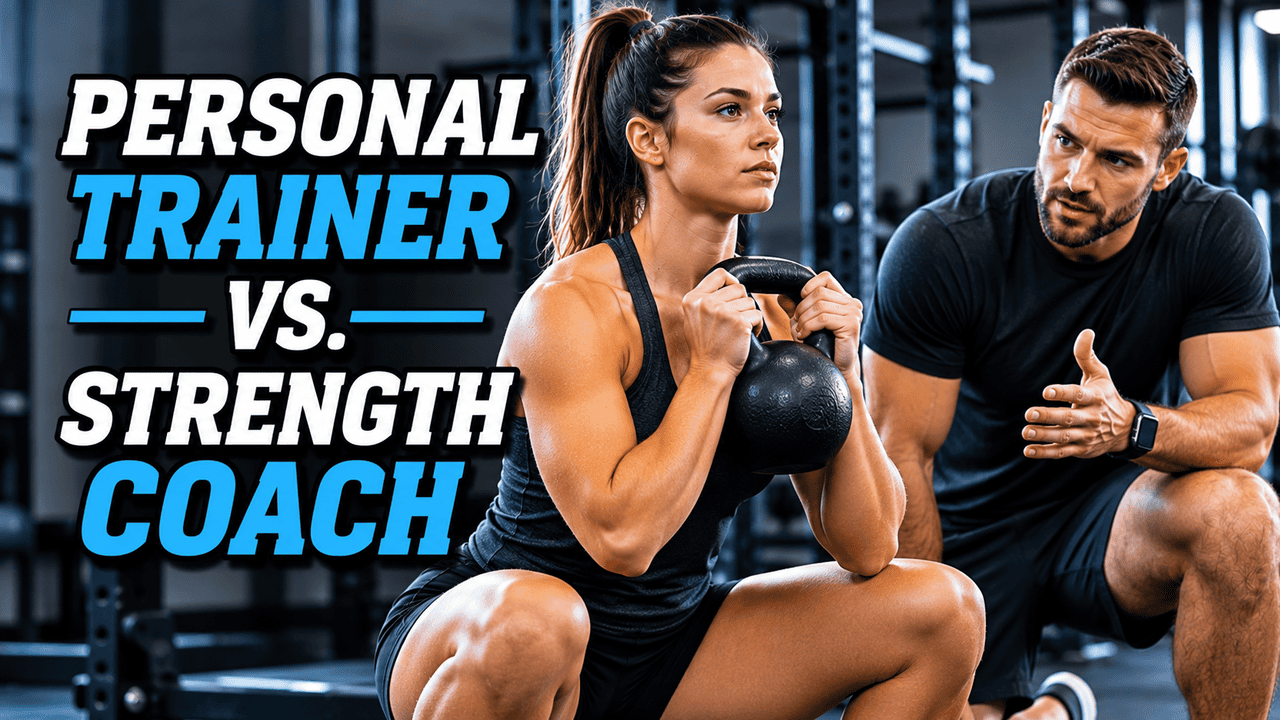
Choosing the right fitness professional is an important step toward achieving your health, strength, and performance goals. Whether you are beginning your fitness journey, returning to exercise after time away, or preparing for competitive athletics, professional guidance can help you train more effectively and confidently.
Two common options are personal trainers and strength and conditioning coaches. Although these professionals share many responsibilities, their areas of expertise, training methods, and approaches to program development can differ.
A personal trainer typically provides individualized exercise instruction, fitness programming, and ongoing support. A strength and conditioning coach often emphasizes athletic development, performance testing, progressive overload, and structured training cycles.
However, these roles are not mutually exclusive. An experienced personal trainer can incorporate advanced strength and conditioning principles, while a strength coach can provide individualized instruction that addresses a client’s specific needs.
At MECA Personal Training, we bring these approaches together. Our training system combines the scientific principles and advanced programming methods of strength and performance coaching with the personalized attention of one-on-one personal training.
This allows us to serve clients across a broad range of experience levels, from individuals learning foundational movements to professional athletes pursuing measurable performance improvements.
Our philosophy is simple: Every client deserves an individualized training program built around their current abilities, long-term goals, and potential for improvement.
Understanding the Role of a Personal Trainer
What Does a Personal Trainer Do?
A personal trainer is a fitness professional who helps individuals improve their physical capabilities through exercise instruction, customized programming, and consistent guidance.
Personal trainers work with clients pursuing many different objectives, including improving strength, increasing muscle mass, managing body composition, enhancing mobility, and developing sustainable exercise habits.
Their responsibilities commonly include evaluating a client’s fitness level, teaching proper exercise technique, designing workouts, monitoring progress, and adjusting programs as clients improve.
One of the most valuable aspects of personal training is individualization. Rather than expecting every person to follow the same routine, a qualified trainer considers the client’s goals, physical limitations, exercise history, and lifestyle.
For beginners, this guidance can establish proper movement patterns and build confidence in the gym. For experienced clients, individualized instruction can refine technique, address weaknesses, and introduce more sophisticated training strategies.
Personal training is not limited to introductory fitness instruction. The depth of programming and expertise available depends on the professional’s education, experience, and training philosophy.
At MECA, our approach to science-based personal training incorporates advanced strength and performance principles while maintaining the individual attention that makes personal training effective.
Who Benefits From Personal Training?
Personal training can benefit nearly anyone seeking structured guidance and measurable physical improvement.
Someone beginning a fitness program may need assistance learning proper lifting mechanics, developing foundational strength, and establishing consistent training habits.
An adult balancing professional responsibilities and family commitments may want an efficient program that improves strength, mobility, and overall physical fitness.
An experienced lifter may need more advanced programming to overcome plateaus or improve specific performance measures.
Competitive athletes may require specialized instruction to develop strength, speed, power, and physical readiness for their sport.
Each individual has different priorities, but all can benefit from knowledgeable instruction, appropriate progression, and ongoing accountability.
The most important consideration is not whether someone qualifies as a beginner or advanced athlete. It is whether the training program matches their needs and provides a clear path toward improvement.
Understanding the Role of a Strength and Conditioning Coach
What Is a Strength Coach?
A strength and conditioning coach specializes in developing physical qualities that contribute to athletic performance.
These qualities may include maximal strength, explosive power, speed, acceleration, muscular endurance, coordination, and movement efficiency.
Strength coaches frequently work with competitive athletes, sports teams, and individuals pursuing specific physical performance goals. Their programs often incorporate exercise science, biomechanics, performance assessments, and periodization.
According to the National Strength and Conditioning Association (NSCA), strength and conditioning professionals use scientific knowledge and practical coaching methods to develop training programs that support physical preparation and athletic performance.
However, the principles of strength coaching are not valuable exclusively to competitive athletes.
Progressive resistance training, movement assessment, structured recovery, and long-term program development can benefit individuals at virtually every fitness level.
A beginner learning to squat safely and a professional athlete developing explosive lower-body power may have very different training requirements, but both can benefit from a systematic approach.
The exercises, intensity, training volume, and performance expectations will differ. The underlying commitment to thoughtful programming remains the same.
What Makes Strength Coaching Different?
Strength coaching is often distinguished by its emphasis on structured physical development over time.
Rather than treating each workout as an isolated event, a strength coach typically organizes training into progressive phases designed to produce specific adaptations.
These phases may emphasize foundational movement, muscular development, maximal strength, or power, depending on the individual’s goals.
Strength coaches also commonly use assessments and performance measurements to guide programming decisions.
For example, an athlete preparing for competition may need to improve acceleration and explosive power. A structured program can target the physical qualities that contribute to those outcomes while accounting for training demands and recovery.
A recreational client may want to improve overall strength and maintain physical capability as they age. The same programming principles can be adapted to support those objectives.
This illustrates an important distinction: Strength and conditioning is a methodology that can be incorporated into personalized training, not an approach reserved for elite athletes.
Personal Trainer vs. Strength Coach: Key Differences
Although personal trainers and strength coaches share many skills, their professional roles often differ in several areas.
Training Objectives
Personal trainers commonly help clients achieve individualized fitness goals, such as improving body composition, developing strength, increasing physical activity, and enhancing overall wellness.
Strength coaches frequently focus on physical qualities associated with athletic performance, including strength, speed, power, and sport-specific conditioning.
These objectives can overlap considerably.
For example, increasing lower-body strength may help an adult improve everyday physical function while also helping an athlete develop greater force production.
The difference is often found in how the program is designed and which outcomes receive the greatest emphasis.
Program Development
Personal training programs can range from general fitness routines to highly advanced, scientifically structured systems.
Strength and conditioning programs often place particular emphasis on long-term progression, planned training phases, and measurable physical adaptations.
Neither approach inherently excludes the other.
A knowledgeable personal trainer can use periodization, movement assessments, progressive overload, and performance testing to create a sophisticated training program.
At MECA, these principles are fundamental to our approach.
Client Experience
Personal training is frequently associated with one-on-one instruction, although some trainers also work with small groups.
Strength and conditioning coaches may work individually with athletes or supervise larger training groups, depending on their professional environment.
The individual attention available in a private personal training setting can be especially valuable when applying advanced strength and conditioning methods.
A trainer can observe technique, provide immediate feedback, adjust exercises, and modify training variables according to the client’s response.
MECA combines this individualized experience with the programming expertise traditionally associated with high-level strength and conditioning.
Professional Education and Credentials
Personal trainers and strength coaches may hold different certifications based on their educational backgrounds and professional specialties.
Common personal training credentials include the Certified Personal Trainer (CPT) certifications offered by organizations such as the NSCA and American College of Sports Medicine (ACSM).
Strength and conditioning professionals may pursue the Certified Strength and Conditioning Specialist (CSCS) credential, which emphasizes exercise science, athletic performance, program design, and related subjects.
These credentials provide useful information about professional preparation, but certification titles alone do not determine coaching quality.
Practical experience, continuing education, assessment skills, communication, and the ability to create effective individualized programs are also important.
An excellent personal trainer may possess extensive strength and conditioning expertise, just as an experienced strength coach may excel at one-on-one personal training.
When selecting a professional, clients should evaluate the complete coaching approach rather than relying solely on a job title.
How MECA Combines Personal Training and Strength Coaching
At MECA Personal Training, we believe clients should not have to choose between individualized attention and advanced training methodology.
Our system integrates the expertise of strength and conditioning coaching with the personal attention, accountability, and customization of private one-on-one training.
This combination allows us to deliver structured, science-based programming while adapting every training experience to the individual.
Personalized Training Supported by Advanced Coaching Principles
Our personal trainers use principles drawn from strength and conditioning to help clients improve their physical capabilities through purposeful, progressive training.
Instead of designing workouts solely around how challenging they feel, we consider how each session contributes to the client’s broader development.
Training variables such as exercise selection, resistance, repetitions, intensity, frequency, and recovery are organized according to individual needs.
This approach supports consistent progress while allowing programs to evolve as clients become stronger and more capable.
For a beginner, the initial focus may involve learning foundational movements, improving coordination, and developing basic strength.
For an experienced adult, programming may emphasize overcoming strength plateaus, improving body composition, or addressing specific movement limitations.
For a competitive athlete, training may focus on developing physical qualities that support sport-specific performance.
The methods are individualized, but the commitment to structured development remains consistent.
A Four-Phase Strength Training System
MECA’s approach incorporates a four-phase strength training system designed to organize physical development through progressive stages.
Rather than relying on disconnected workouts, our training philosophy emphasizes building upon previously developed capabilities.
The program considers foundational movement quality, strength development, and more advanced performance qualities according to each client’s readiness and objectives.
Progression is not based solely on how long someone has been training. It also depends on demonstrated technique, physical capacity, recovery, and measurable improvement.
This system allows us to apply advanced programming principles without requiring every client to train like a professional athlete.
Someone who has never worked with a personal trainer can begin with an appropriate foundation, while an experienced athlete can pursue more demanding performance objectives.
Both receive training designed around their individual starting point.
One-on-One Attention in a Private Training Environment
One of the defining features of MECA Personal Training is our one-on-one coaching model.
Every training session provides dedicated instruction from a personal trainer who can observe movement, offer feedback, and make adjustments as needed.
This individualized attention is especially valuable when incorporating technical exercises and progressive resistance training.
Our 60-minute sessions provide a structured opportunity for appropriate preparation, focused training, and ongoing coaching.
The exact activities within each session depend on the client’s program and current training phase.
This private environment supports clients who are learning exercises for the first time as well as experienced individuals working toward advanced performance goals.
The objective is to provide the right level of instruction and challenge for each person.
Why the Initial Assessment Matters
A successful training program begins with understanding the individual.
At MECA, the initial assessment is an important part of developing a personalized approach to strength and physical performance.
Rather than immediately placing clients into a predetermined workout routine, we evaluate relevant factors that influence exercise selection, training progression, and long-term goals.
Evaluating Movement and Mobility
Movement quality provides valuable information about how someone performs fundamental physical tasks.
An assessment may examine mobility, stability, coordination, and movement mechanics during selected exercises.
These observations help identify areas that may benefit from additional instruction or targeted training.
For example, someone who struggles to maintain proper positioning during a squat may need to improve movement control or mobility before progressing to heavier resistance.
Another client may demonstrate strong foundational mechanics and be ready for more advanced training.
Neither outcome determines whether someone belongs in a personal training program. Instead, the assessment helps establish an appropriate starting point.
Reviewing Strength and Physical Capabilities
Understanding a client’s current strength and physical capacity helps our trainers select suitable exercises and establish realistic progression targets.
Assessments may include strength-related measurements or movement-based evaluations appropriate to the individual’s experience.
For beginners, the emphasis may be on establishing safe technique and identifying manageable starting loads.
For experienced athletes, more advanced testing may help identify strengths, weaknesses, and opportunities for performance improvement.
The goal is to use relevant information to guide training decisions rather than relying on assumptions.
Considering Training History and Individual Goals
A client’s previous exercise experience, injury history, current physical condition, and personal objectives all influence program design.
Someone returning to fitness after several years may need a different progression than someone who has trained consistently for a decade.
Similarly, a recreational runner, a working professional, and a competitive football player may benefit from different exercise selections and training priorities.
Our assessment process helps us understand these differences so that each program reflects the client’s individual circumstances.
Clients with active injuries or medical concerns may also need clearance or guidance from an appropriate healthcare professional before participating in certain activities.
The Science of Periodization and Progressive Training
What Is Strength and Conditioning Periodization?
Periodization is the planned organization of training variables over time to support specific physical adaptations.
These variables may include training intensity, volume, frequency, exercise selection, and recovery.
Rather than attempting to improve every physical quality simultaneously, periodized programs organize training into phases with defined priorities.
For example, a program may initially emphasize movement proficiency and foundational strength before progressing toward heavier resistance or more demanding power exercises.
The structure depends on the individual’s goals, experience, and physical readiness.
Periodization is commonly associated with competitive athletics, but its principles can benefit recreational clients and beginners as well.
Why Structured Progression Matters
Physical improvement requires appropriate training challenges followed by sufficient recovery.
When exercise programs remain unchanged for extended periods, clients may eventually experience plateaus.
Conversely, increasing training demands too aggressively can contribute to excessive fatigue or overuse problems.
A structured program balances progressive overload with recovery and ongoing evaluation.
At MECA, we use this approach to help clients develop strength and physical capabilities over time.
A beginner may progress by improving exercise technique, increasing repetitions, or gradually adding resistance.
An experienced lifter may benefit from more detailed adjustments to training volume, intensity, and exercise selection.
An athlete may require carefully organized training phases that account for competition schedules and sport-specific demands.
For example, a runner may benefit from strength training for runners that emphasizes lower-body strength, stability, and movement efficiency while accounting for running volume and recovery.
In each situation, the objective is to create meaningful progression rather than simply making every workout more difficult.
Safety, Supervision, and Professional Training Standards
Why Professional Supervision Matters
Safety is a fundamental consideration in any strength training program.
Although resistance training can be appropriate for individuals across a wide range of ages and experience levels, proper exercise instruction and suitable progression are essential.
The NSCA Professional Standards and Guidelines emphasize qualified supervision, appropriate exercise instruction, equipment maintenance, and organized training environments.
A knowledgeable trainer helps clients understand proper technique, recognize exercise limitations, and progress at an appropriate rate.
Professional supervision can also help identify movement errors before they become established habits.
At MECA, our one-on-one personal training model allows our trainers to closely observe each client’s technique throughout the session.
This provides opportunities for immediate instruction and exercise adjustments based on individual needs.
The Importance of Proper Exercise Technique
Exercise technique influences how effectively and comfortably an individual performs resistance training.
Proper instruction helps clients learn appropriate positioning, movement control, and lifting mechanics.
For beginners, learning these fundamentals can establish confidence and provide a foundation for future progress.
For experienced clients, technique refinement can improve exercise consistency and help identify movement limitations.
As training demands increase, maintaining appropriate technique becomes especially important.
Our trainers use individualized coaching to help clients develop the skills necessary for their current program and future training progression.
Individualized Training Loads and Progression
Not every client should begin with the same exercises, resistance levels, or training intensity.
A person new to strength training may benefit from lighter resistance and additional technique instruction.
An experienced athlete may be ready for more advanced movements and greater training demands.
The appropriate starting point depends on the individual’s capabilities, training history, and goals.
MECA’s assessment-driven approach allows us to select suitable exercises and adjust training variables as clients progress.
This helps create a training experience that is challenging without unnecessarily exceeding the individual’s current capabilities.
The Benefits of One-on-One Supervision
Strength and conditioning programs are often delivered in group environments, where coaches supervise several participants simultaneously.
Professional organizations such as the NSCA provide supervision guidelines to help facilities maintain appropriate training conditions.
MECA’s private one-on-one model offers a different experience.
Rather than dividing attention among a group, our personal trainers focus on one client throughout the session.
This allows for individualized exercise instruction, immediate technique feedback, and ongoing adjustments to the training program.
Our philosophy of goal-oriented personal training emphasizes purposeful exercise selection and measurable progression rather than disconnected workouts.
The result is a personalized training environment that supports both foundational fitness development and advanced strength training.
How Often Should You Work With a Personal Trainer?
Training frequency plays an important role in building strength, improving physical fitness, and developing consistent exercise habits.
At MECA, we generally recommend beginning with three to four training sessions per week.
This frequency provides regular opportunities to practice movements, develop strength, and establish a consistent training routine.
It also allows training volume and intensity to be distributed across the week rather than concentrated into occasional sessions.
However, the ideal schedule depends on several individual factors.
A client’s experience, recovery capacity, physical condition, outside activities, and specific goals can all influence the recommended frequency.
Someone beginning strength training may follow a program that emphasizes foundational exercises and gradual progression.
An experienced athlete may require a different distribution of training intensity and recovery based on competitive demands.
Our trainers consider these factors when developing an individualized schedule.
The goal is to establish a sustainable training frequency that supports measurable improvement while allowing appropriate recovery.
What Happens During a 60-Minute MECA Training Session?
MECA personal training sessions are 60 minutes long.
This format allows our trainers to organize each session around the client’s individual program and current training priorities.
A session may begin with an appropriate warm-up and movement preparation, followed by the primary exercises selected for that training phase.
Depending on the client’s goals, the workout may emphasize strength development, muscular conditioning, movement quality, or athletic performance.
Additional exercises may address supporting muscle groups, mobility, stability, or other identified needs.
Throughout the session, the trainer provides instruction, monitors technique, and adjusts training demands when appropriate.
The purpose is not simply to complete a predetermined number of exercises.
Each session contributes to a larger training plan designed around the client’s long-term development.
Choosing the Right Training Approach for Your Goals
If You Are New to Strength Training
Beginning a fitness program can feel intimidating, especially when exercises, equipment, and training terminology are unfamiliar.
Working with a qualified personal trainer provides guidance during this important learning period.
At MECA, beginners receive individualized instruction designed to establish proper movement patterns, foundational strength, and confidence.
Our trainers meet clients at their current level rather than expecting them to arrive with previous training experience.
The same scientific principles used in advanced strength and conditioning can be adapted to help beginners develop a strong foundation.
This means you do not need to be an athlete or experienced lifter to benefit from MECA’s approach.
If You Want to Improve General Fitness and Strength
Many clients want to become stronger, improve body composition, increase physical capability, or establish a more consistent exercise routine.
These goals benefit from structured programming and ongoing guidance.
At MECA, we help clients pursue these objectives through customized strength training built around measurable progression.
Our trainers consider each person’s current fitness level and adapt the program as their capabilities improve.
Whether your goal is to feel stronger during everyday activities or develop a more advanced level of fitness, the program should reflect your individual priorities.
If You Have Reached a Training Plateau
Experienced exercisers sometimes reach a point where their usual workouts no longer produce the desired improvements.
A plateau may result from several factors, including insufficient progression, inadequate recovery, inconsistent programming, or training variables that no longer match the individual’s goals.
A structured assessment can help identify areas that deserve attention.
MECA’s training approach incorporates progressive programming and ongoing evaluation to help clients move beyond unproductive routines.
Adjustments may involve exercise selection, training intensity, volume, recovery, or technique.
Rather than introducing random changes, we focus on developing a purposeful progression strategy.
If You Are a Competitive or Professional Athlete
Athletes often have specialized physical demands related to their sport and competitive schedule.
Developing strength, power, speed, and movement efficiency may require advanced training methods and carefully organized programming.
MECA’s strength and performance coaching expertise supports athletes seeking to improve these physical qualities.
Our system has been used in the development of professional athletes, including individuals competing in the NFL, NHL, and Olympic sports.
Under the leadership of Head Strength and Conditioning Coach David Lawrence, MECA applies performance-focused principles to individualized training programs.
For developing athletes, our strength coach tips for young athletes further illustrate the importance of foundational strength, appropriate progression, and long-term physical development.
However, the expertise behind this system is not reserved for professional competitors.
It is part of the foundation of our personal training approach for clients at every experience level.
The MECA Standard: Advanced Expertise With Personalized Attention
The quality of a training program depends on more than the professional title of the person delivering it.
Effective coaching requires knowledge, assessment skills, practical experience, communication, and the ability to adapt programming to individual needs.
At MECA Personal Training, our approach reflects the intersection of advanced strength and conditioning methodology and individualized personal training.
Our coaching philosophy emphasizes understanding each client, developing an appropriate training strategy, and measuring progress over time.
This allows us to support a wide range of objectives without compromising our commitment to structured, evidence-informed training.
Experience That Supports Clients at Every Level
MECA’s training system is led by David Lawrence, whose experience includes working with professional athletes from major competitive sports.
That background contributes to the strength and performance principles behind our programming.
However, we recognize that not every client has professional athletic goals.
Some individuals want to develop confidence in the gym. Others want to improve strength, enhance mobility, support healthy aging, or pursue personal performance milestones.
Our responsibility is to apply our expertise appropriately to each individual.
A beginner should receive the instruction and progression needed to build a foundation.
An experienced client should receive programming that reflects their existing capabilities and future objectives.
An athlete should receive training aligned with the physical demands of their sport.
This flexibility is central to our personalized training model.
Progress Based on Individual Development
We believe meaningful progress should be evaluated according to each client’s starting point and goals.
For one person, progress may involve learning to perform foundational exercises with greater confidence.
For another, it may involve increasing strength, improving movement efficiency, or achieving a measurable athletic performance target.
Our assessment-driven approach helps establish appropriate benchmarks and provides a framework for monitoring improvement.
As clients progress, their programs can evolve to reflect new capabilities and objectives.
This commitment to individualized development is what allows MECA to combine advanced coaching expertise with the accessibility and personal attention of one-on-one training.
Frequently Asked Questions
Is a Personal Trainer Considered a Coach?
Yes. Personal trainers provide coaching through exercise instruction, individualized programming, motivation, and ongoing guidance. The distinction between a personal trainer and a strength coach often relates to specialization and professional responsibilities rather than whether one provides coaching and the other does not.
At MECA, our personal trainers incorporate strength and performance coaching principles into individualized training programs.
Can a Personal Trainer Help With Strength and Athletic Performance?
Absolutely. A personal trainer with appropriate education and experience can develop programs that improve strength, power, movement quality, and athletic capabilities.
MECA combines advanced strength and conditioning methodology with personalized one-on-one instruction to support clients pursuing both general fitness and performance-focused goals.
Do You Need to Be an Athlete to Train at MECA?
No. MECA Personal Training works with individuals across a wide range of experience levels, including complete beginners, recreational exercisers, experienced lifters, and competitive athletes.
Our programs are tailored to each client’s current abilities, training history, and personal goals.
How Often Should You Work With a Personal Trainer?
At MECA, we generally recommend three to four training sessions per week as a starting point. This provides consistent opportunities for exercise instruction, strength development, and structured progression.
Individual schedules may be adjusted according to training experience, recovery needs, and specific goals.
How Long Is a MECA Personal Training Session?
MECA personal training sessions last 60 minutes. Each session follows an individualized program that may include movement preparation, strength exercises, technique instruction, and other training activities appropriate to the client’s goals.
What Happens During an Initial Personal Training Assessment?
An initial assessment helps establish a client’s starting point by reviewing relevant factors such as movement quality, mobility, strength, training experience, injury history, and personal objectives.
At MECA, this information helps guide individualized program development and appropriate training progression.
What Is the Difference Between a CPT and a CSCS?
A Certified Personal Trainer (CPT) credential generally emphasizes individualized fitness instruction, exercise programming, and client support.
The Certified Strength and Conditioning Specialist (CSCS) credential places additional emphasis on exercise science, athletic performance, and strength and conditioning program design.
Both credentials can support professional development, and many coaching principles overlap.
Is Strength Training Appropriate for Beginners?
Yes. Appropriately designed strength training can benefit beginners by developing foundational strength, improving movement skills, and increasing physical confidence.
Working with a qualified personal trainer helps ensure exercises and training demands are selected according to the individual’s current capabilities.
Why Is Periodization Important in Personal Training?
Periodization organizes training variables into planned phases to support progressive physical development.
It can help trainers manage training intensity, volume, and recovery while aligning workouts with longer-term goals.
At MECA, structured progression is an important component of our individualized training philosophy.
Can Personal Training Help Experienced Athletes?
Yes. Experienced athletes can benefit from individualized programming, technique refinement, performance assessments, and structured strength development.
MECA’s training system combines these advanced coaching principles with dedicated one-on-one instruction.
Experience the Best of Personal Training and Strength Coaching at MECA
Choosing between a personal trainer and a strength coach does not have to mean sacrificing individualized attention for advanced training expertise.
At MECA Personal Training, we combine both.
Our approach brings together the science, structure, and performance-focused principles of strength and conditioning with the personalized instruction and accountability of private personal training.
Whether you are beginning your fitness journey, working to become stronger, overcoming a training plateau, or preparing for competitive athletics, our system is designed to meet you at your current level.
We begin by understanding your abilities, experience, and goals. From there, we develop an individualized program built around appropriate progression, professional instruction, and measurable improvement.
Our 60-minute one-on-one training sessions provide focused coaching within a structured program, with a general starting recommendation of three to four sessions per week.
You do not need to be a professional athlete to benefit from advanced training principles. You simply need a program designed for your goals and a knowledgeable trainer committed to helping you progress.
At MECA, we believe every client deserves that level of attention and expertise.
Contact MECA Personal Training today to schedule your initial assessment and discover how our combination of personalized training and advanced strength coaching can help you build strength, improve performance, and work toward your individual fitness goals.