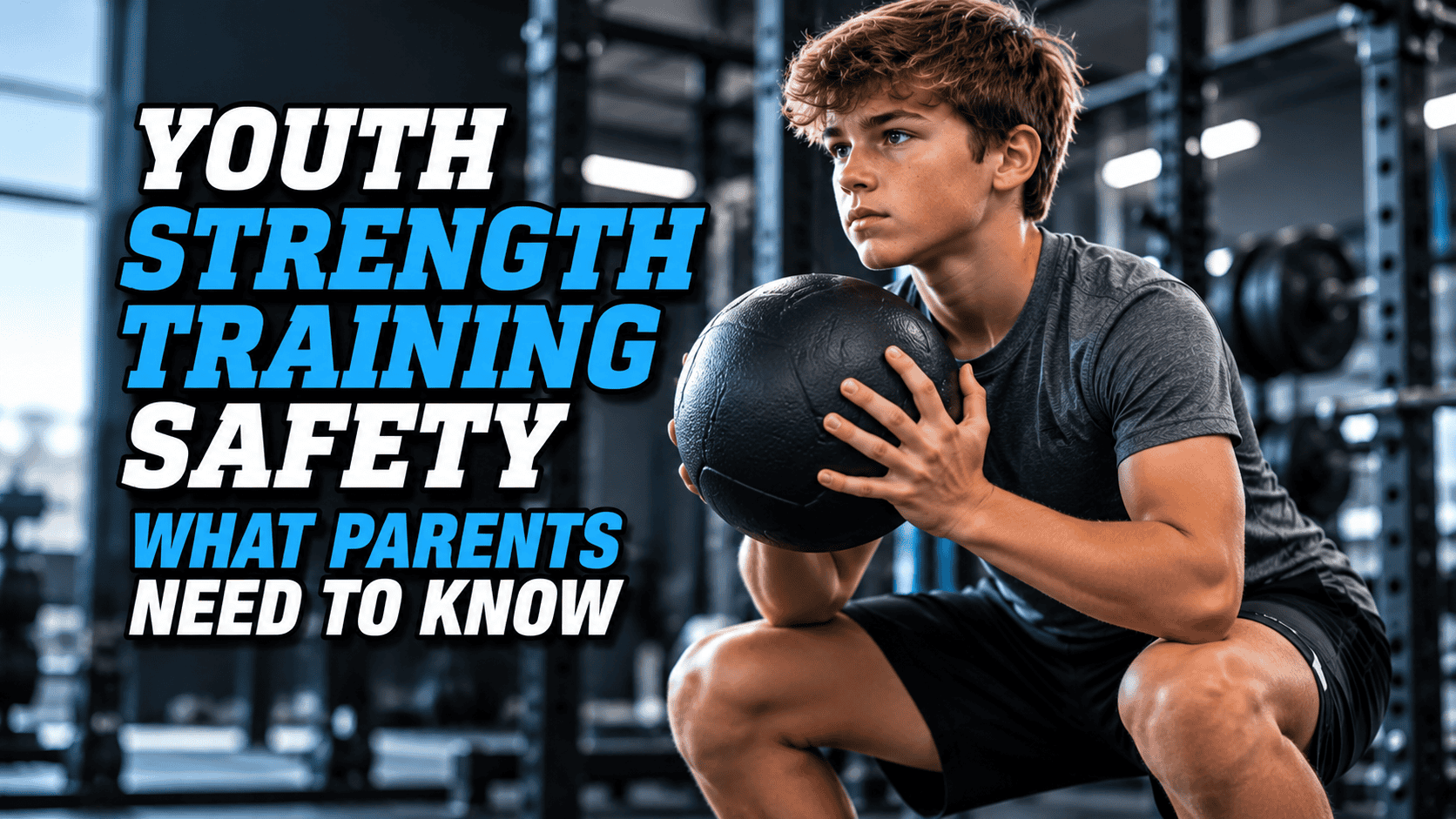

Properly supervised youth strength training is safe for youth athletes and does not stunt growth. The science is clear. That is the clear consensus of sports science and pediatric medicine: a standard established for more than two decades. The concern parents most often harbor in their first conversation with a coach, the fear that lifting weights will damage growth plates or derail physical maturation, is not supported by evidence. The veritable risk lies elsewhere: in unsupervised environments, poorly credentialed coaches, and programs that prioritize heavy loads over movement quality. Understanding that distinction gives parents the foundation to make informed decisions about their child’s athletic development.
The Science of Youth Resistance Training and Growth Plates
For years, the worry about growth plate injuries in young athletes was enough to keep entire generations off the weight room floor. That caution was not unreasonable given the limited research available at the time, but extensive literature reviews have since shifted the medical consensus. The British Journal of Sports Medicine international consensus and a PubMed study on youth resistance training safety both confirm that properly supervised youth strength training does not negatively affect growth in height or weight, nor does it impede skeletal maturation in pre- and early-pubertal youth. Growth plate injuries in youth strength programs, when they do occur, are almost exclusively tied to unsupervised settings, inappropriate loading, or acute accidents, rather than structured, coach-led environments. The modality itself is not the hazard; the conditions surrounding it are.
Major medical organizations have arrived at the same conclusion. The American Academy of Pediatrics published an official policy statement on youth strength and weightlifting that formally supports resistance training for children and adolescents when programs are designed and supervised correctly. That institutional endorsement matters because it reflects a synthesis of clinical and performance data, not just isolated studies. Structured programs produce measurable improvements in muscular strength, speed-strength, cardiorespiratory fitness, and body composition: adaptations that carry forward into competitive athletic careers and lifelong physical health.
Quantifiable Benefits of Early Strength and Conditioning
The case for starting early goes well beyond injury prevention. Youth athletes who engage in structured resistance programs develop physical literacy: the movement competency, spatial awareness, and body control that underpin performance across every sport, during the developmental window when those skills are most efficiently acquired. According to a PMC neuromuscular training study, youth athletes can experience average strength increases of 30% to 50% over a multi-week structured training program. That magnitude of adaptation, achieved during formative years, creates a compounding athletic advantage that generic recreational activity simply cannot replicate.
The performance benefits extend across multiple physical domains:
- Enhanced Motor Skills: Coordination, balance, and movement efficiency improve across all sports, not just the primary one a child plays.
- Increased Bone Density: Resistance training stimulates bone mineralization during critical growth years, building a skeletal frame that is more resilient to the demands of competitive sport.
- Injury Prevention Shield: Preparing the musculoskeletal system to absorb and redirect force reduces the incidence of overuse injuries: the most common category of harm in youth sport.
- Documented gains in self-esteem and body confidence emerge as young athletes track tangible, metric-based progress over time, reinforcing the consistency that long-term athletic development demands.
Ready to establish a safe, assessment-driven training baseline for your child? MECA 1-on-1 elite coaching begins with a detailed evaluation of your child’s movement patterns and individual needs before any load is introduced.
Age-Appropriate Progression and Training Guidelines
Children as young as 10 to 11 years old can safely begin formal weightlifting training, according to a PMC sports science review on youth resistance training progression, provided they demonstrate the necessary biological maturity, meaning emotional readiness and the capacity to follow technical instruction, rather than simply reaching a chronological age threshold. Chronological age is a poor proxy for training readiness; two 11-year-olds can differ substantially in skeletal development, attentional capacity, and movement quality. A well-designed program accounts for those individual differences from the first session. For a detailed look at how a structured, multi-phase approach maximizes both safety and performance, the framework outlined in this strength training program for athletes illustrates how progressive loading works across development stages.
For prepubertal children between ages 8 and 10, the programming emphasis belongs on movement quality, not load. The PMC sports science review recommends 8 to 12 repetitions per set, substantial exercise variation, and light loads or bodyweight movements to develop fundamental movement patterns. Equally important is the overall program composition: during the initial years of training, specialized sport work should not exceed 40% of total volume, with at least 50% to 60% dedicated to general physical preparation: basic gymnastics, track and field, court games, and similar activities that build broad athletic capacity. Early specialization compresses the developmental window and tends to produce athletes who are technically proficient in one narrow domain but physically underprepared for the demands that emerge at higher competition levels.
Age-appropriate training milestones provide a useful structural guide:
- Ages 8 to 10 (Prepubertal): Bodyweight exercises, medicine ball throws, resistance bands, and high-repetition sets (8 to 12 reps) to master foundational movement patterns.
- Ages 10 to 11 (Introductory): Introduction to light external resistance, such as dumbbells or light barbells, and formal weightlifting technique, with form prioritized entirely over load.
- Ages 12 to 14 (Adolescent): Structured resistance training with gradual weight progression, introducing compound lifts under strict supervision as movement quality is confirmed.
- Ages 15+ (Advanced): High-performance programming calibrated to specific sport demands, incorporating advanced strength and conditioning methodologies appropriate to the athlete’s competitive level.
“I would not still be in the NFL if it wasn’t for training with David at MECA. In 2014, I came in for an evaluation, and David showed me what was limiting my speed and power production. In one off-season, I increased my speed and strength more than I had previously done in the last 10 years training in college or the NFL. I increased my bench press by 91 pounds that off-season and was able to rehab an old hamstring injury that slowed me down and caused a lot of pain. Training with Dave and MECA has added more years to my career, and I am running faster and playing stronger than ever before. Headed into my 8th year in the NFL, I am getting better each year physically, and it’s due to the continuous workouts and training at MECA.” – Frank Zombo, Kansas City Chiefs, 7-year NFL veteran and Super Bowl Champion
Injury Prevention and Gender-Specific Training
One of the more underappreciated dimensions of youth strength programming is its role in preventing the injuries that end seasons and, in some cases, careers. This is particularly acute for female athletes, where biomechanical and hormonal differences, including lower absolute upper-body strength, a lower rate of force development, and a longer electromechanical delay, create measurable disparities in injury vulnerability. Female youth athletes who participate in neuromuscular resistance training see a 75% to 100% reduction in ACL injury rates, according to a PubMed ACL injury prevention study. That figure is striking, and it points to something the PMC sports science review reinforces: targeted program modifications, such as additional upper-body work, reactive strength training, and exercises that address the biomechanical factors linked to anterior cruciate ligament injuries, are not optional enhancements for female athletes; they are a core component of responsible programming. While qualitative strength adaptations are broadly similar between sexes, ignoring the morphological differences when designing a youth program is a meaningful oversight.
Identifying Red Flags in Youth Strength Programs
Not every program that markets itself to young athletes meets the standards the research demands. Many fall short. Parents evaluating local options should watch for these warning signs:
- Lack of Qualified Instruction: Coaches without specialized youth training credentials or certifications from recognized bodies like the NSCA are a significant liability in a youth setting.
- High Coach-to-Athlete Ratios: The NSCA recommends ratios of 1:10 or lower for junior high and younger athletes, and 1:15 or lower for high school athletes (per the PMC sports science review). Programs that routinely exceed these thresholds cannot deliver the technical supervision youth athletes require.
- Inappropriate Training Loads: Any program that advances weight before an athlete has demonstrated technical mastery of the movement is prioritizing optics over safety.
- Training to Failure: Pushing prepubertal children to muscular failure severely compromises form and meaningfully elevates injury risk: it is a practice with no defensible place in youth programming.
- Promoting Unsafe Weight Loss: Intentional dehydration, sauna use, or body wraps as weight-management tools are red flags regardless of the athlete’s age or sport (per the PMC sports science review).
- No Onboarding Assessment: Placing a child directly into a workout without first evaluating their movement quality, injury history, and baseline capabilities signals that the program was not built around the individual athlete.
At MECA, safety is engineered into the program architecture rather than treated as a compliance checkbox. Every youth athlete begins with an individual biomechanical assessment that maps movement limitations, flags previous injuries, and establishes a verified baseline before any progressive loading begins. That process is not procedural theater; it is the mechanism that keeps injury rates low. Supervised youth resistance programs, when run correctly, produce injury rates estimated between 0.053 and 0.176 injuries per 100 participant-hours (per the PubMed study on youth resistance training safety). Longitudinal tracking of young weightlifters has shown zero lost training days or medically significant injuries over a full year of training and competition when proper technique was maintained throughout (per the PMC sports science review). Those numbers reflect what structured, expert-supervised training truly produces, and they stand in sharp contrast to the outcomes common in unsupervised or poorly managed environments.
Frequently Asked Questions About Youth Strength Training
At what age should a kid start strength training?
Most experts agree that children can begin strength training as soon as they are mature enough to follow instructions and maintain proper form, typically around age 7 or 8. At this stage, the focus must remain entirely on bodyweight movements, light resistance, and the development of physical literacy rather than lifting heavy weights. The goal is building movement competency, not accumulating load.
Is it okay for a 12-year-old to start lifting weights?
Yes, and when done correctly, it is genuinely beneficial. A 12-year-old using light resistance and working on proper technique is building a strong muscular foundation. This technical supervision establishes a movement vocabulary that serves them throughout their athletic career. The structured resistance training appropriate for this age group prepares the body for the physical demands of competitive sports in a way that recreational activity alone does not.
What is a good strength training program for youth?
A well-constructed youth program centers on fundamental movement patterns: squats, lunges, pushes, and pulls, using bodyweight or light resistance with high repetitions to reinforce form before load is introduced. Equally important is the program’s overall composition: at least 50% to 60% of total training volume during the early years should consist of general physical preparation, including basic gymnastics, track and field, and court games (per the PMC sports science review). Programs that skip this foundation and move directly into sport-specific or heavy loading tend to produce athletes who are strong in a narrow range of motion but brittle outside it.
What is the 3-3-3 rule for strength training?
The 3-3-3 rule is a simplified framework suggesting 3 sets of 3 exercises performed 3 times per week. For youth athletes just entering structured training, it provides a manageable and consistent routine that does not overwhelm physical or mental capacity. It works well as an introductory scaffold, though most athletes will benefit from more individualized programming as their movement quality and work capacity develop.
What are the best three strength training exercises?
The three compound movements most consistently cited across strength and conditioning literature are the squat, the push-up or bench press, and the row or pull-up. Each recruits large muscle groups across multiple joints, builds functional strength that transfers to sport, and forms the structural core of any serious athletic development program. For youth athletes, the emphasis at the outset belongs on movement quality within these patterns: depth, alignment, and control, before load becomes part of the conversation.
Book Your Assessment Today
Choosing the right environment for your child’s physical development carries more weight than most parents initially realize. A generic gym setting without qualified supervision, appropriate coach-to-athlete ratios, or individualized programming is not a neutral choice: it is a meaningful risk. By prioritizing movement quality, strict supervision standards, and individualized biomechanical programming from the start, you protect your child from the injuries that derail athletic trajectories and give them the physical foundation to compete at the highest level their potential allows.
Ready to give your child a genuine competitive advantage, built safely from the ground up? Book your 1-on-1 assessment and experience how we deliver 3 Years of Results in 3 Months through MECA 1-on-1 elite coaching today. Contact our primary facility at (313) 246-9614.